Ti-Base Explained: Abutment Differences and Height
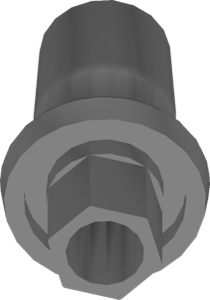
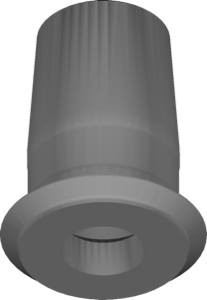
Ti-Base — what it is in practice: a metallic titanium base that screws into the implant and serves as an adhesive foundation for a crown or framework produced through a digital protocol. In English the term is written several ways: Ti-Base, titanium base, ti base, TiBase — all the same component. It has become the backbone of screw-retained and hybrid fixation in CAD/CAM and appears in 139 libraries in our catalog.
In this article we'll break down how a Ti-Base differs from a classic abutment, what engaging and non-engaging mean, how to choose base height and gingival height, and how all of this fits into the exocad DentalCAD workflow.
What Is a Ti-Base in Simple Terms
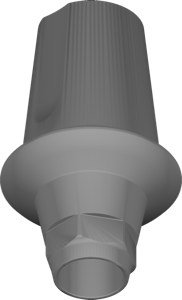
A Ti-Base is a ready-made factory titanium interface with a fixed connection geometry to the implant (conical, hex, tri-lobe — depending on the system). The upper part of the base has a cylindrical or slightly conical surface with retentive geometry: a custom restoration made of zirconia, lithium disilicate, or PMMA is cemented onto it. Hence the alternative name — bonding base.
The core idea is separating the interface from the esthetics. A precise fit to the implant is delivered by factory titanium, while the shape, emergence profile, and color are defined by the milled or printed superstructure. The restoration can be screw-retained (the access channel runs through the Ti-Base) or cemented onto the base outside the mouth, with the assembly then screwed to the implant — this is how a screw-retained hybrid crown works.
Ti-Base vs Abutment: What's the Difference
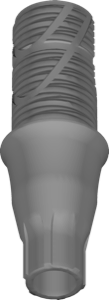
A classic stock abutment is a one-piece part onto which a crown is cemented directly in the mouth, while a custom milled abutment is made entirely from a titanium blank with the interface in a single milling operation. A Ti-Base occupies the middle ground: a factory titanium base plus a custom ceramic superstructure bonded on.
Key differences. A Ti-Base is cheaper and faster to produce than a fully milled titanium abutment and offers better esthetics thanks to the zirconia part at the gingival margin. A solid titanium abutment is stronger under extreme loads and large angulation corrections but loses out on color in the smile zone. A stock abutment is the simplest and cheapest option but with minimal profile customization.
A separate case is the cuttable Ti-Base (for example, Cuttable Ti Base from Zimmer Biomet, Nobel, and Dentsply Astra in the catalog). Such a base can be shortened in height to fit the clinical situation, which is handy in limited interocclusal space.
Engaging vs Non-Engaging: When to Choose Each
An engaging (anti-rotational) Ti-Base has geometry that enters the anti-rotational part of the implant and fixes the restoration's position. It's used for single crowns where protection against rotation is needed.
A non-engaging (NI, no anti-rotation) base does not enter the anti-rotational part and allows free positioning. This is the mandatory choice for bridges and bars on multiple implants: without that free play you can't passively seat a framework on non-parallel implants. The catalog shows this right in the names — for example, Dentsply Sirona TitaniumBase EV ASA S 3mm (engaging) and its EV ASA S 3mm NI version (non-engaging).
How to Choose Ti-Base Height and Gingival Height
A Ti-Base has two independent height parameters that are often confused. Gingival height (GH) is the height of the polished collar from the implant platform to the start of the adhesive zone. It defines how deep the restoration goes below the gingiva and is selected according to soft-tissue thickness. In the catalog, Dentsply Sirona TitaniumBase EV ASA comes in gingival heights of 1 mm, 2 mm, 3 mm, and 4 mm — used as a reference for a specific biotype.
How to choose GH: the thicker the gingiva and the deeper the implant is placed, the greater the gingival height. Too low a collar leaves titanium exposed and worsens the emergence profile; too high reduces the bonding area for zirconia.
The second parameter is the bonding height (bonding cylinder height). The greater it is, the stronger the cement fixation, but with limited interocclusal distance the height has to be reduced or you take a cuttable version and trim it. Check exact dimensions in the manufacturer's specification and the library description — you can't guess millimeters by eye.
There are also variants by letter marking (S/L/XL in the EV ASA line — short, long, extra-long) that combine different gingival heights and interface lengths for clinical situations.
Ti-Base in exocad DentalCAD: Workflow and Libraries
In exocad DentalCAD a Ti-Base is loaded as an implant library: the software receives the exact geometry of the connection, the adhesive zone, and the gingival height, as well as the screw-channel parameters. The fit of the restoration depends directly on the library's accuracy, so it must be chosen strictly for the specific system and base variant, not a "similar" one.
The DentalLibs catalog has ready-made libraries for most systems: Straumann CAD-CAM Ti Base, Nobel Biocare CAD-CAM Ti Base, Thommen Ti-Base, Camlog ti-base CADCAM crown, Dentium SuperLine Ti-Base Link, plus the Dentsply Sirona TitaniumBase EV ASA line with different gingival heights. They conveniently cover single crowns, bridges, and hybrid structures.
Before starting the design, check three things: the implant system and platform, the base type (engaging/non-engaging), and the gingival height. An error in any of these will lead to a misfit of the framework or an incorrect emergence profile.
Ti-Base FAQ
How Does a Ti-Base Differ from an Abutment?
A Ti-Base is a factory titanium base onto which a custom ceramic superstructure is bonded; a classic abutment is more often one-piece. A Ti-Base delivers better esthetics at the gingival margin and is cheaper than a fully milled titanium abutment, but it's weaker under heavy loads.
Can a Ti-Base be reused?
No. The titanium base is a single-use component; refixing compromises adhesion and the accuracy of the fit to the implant.
Engaging or non-engaging for an implant bridge?
Non-engaging (NI), to ensure passive seating of the framework on non-parallel supports.
Which gingival height to choose?
Base it on soft-tissue thickness and implant placement depth: thin biotype — lower GH (1–2 mm); thick tissue and deep placement — higher (3–4 mm).