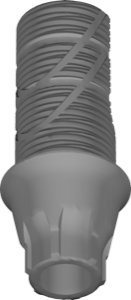
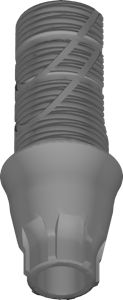
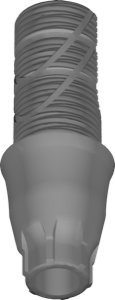
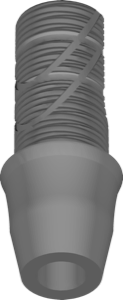
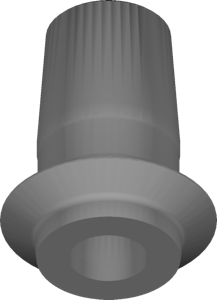
Ti-Base Gingival Height: How to Pick 0.5/1/2/3 mm
Gingival height (gingival height, GH) is a titanium base parameter that defines where the Ti-Base margin sits relative to the gum line. The way you choose the Ti-Base gingival height determines the esthetics of the restoration margin, access to the cementation zone and how accurately the crown seats on the scan marker. In manufacturer catalogs the same base geometry comes in 0.5, 1, 2 and 3 mm versions — these are not interchangeable SKUs but different heights of the transgingival portion.
Below we break down what each value physically means, how to measure gum thickness for a given case, and why exocad has a separate CAD library for each height.
What gingival height means on a Ti-Base
A titanium base (Ti-Base) consists of the implant connection, the transgingival portion and the cylindrical bonding zone onto which the milled or printed crown is seated. Gingival height is the height of that transgingival portion specifically: the greater it is, the higher the bonding margin rises above the implant platform.
The practical meaning is simple: gingival height sets the position of the cement line relative to the soft tissue. A low collar (0.5–1 mm) keeps the line closer to the platform and deeper under the gingiva; a high one (2–3 mm) raises it coronally, closer to the gum margin.
For deeply placed implants and a thick gingival biotype this is critical: without sufficient GH the bonding line runs too deep under the tissue, and removing excess cement or composite becomes impossible.
How to measure gingival height for a Ti-Base
The starting point is the implant placement depth and the soft tissue thickness over the platform. This is assessed with a periodontal probe against the healing abutment, from an impression with a transfer coping, or from an intraoral scan taking the scan body position into account.
A guide for selecting GH:
- thin biotype, platform close to the crest — 0.5–1 mm;
- medium tissue thickness, standard depth — 1–2 mm;
- thick biotype or subcrestal placement — 2–3 mm;
- multi-unit restorations at tissue level — often increased GH or Multi-Unit.
The goal is for the bonding margin to sit roughly at or slightly below the gum line while remaining accessible. Too low a GH hides the line deep in the sulcus; too high a GH exposes the metal of the collar.
0.5, 1, 2 or 3 mm: how to choose the gingival height
The selection logic is driven by implant depth and gum thickness, not by the esthetic zone as such. 1 mm is a universal option for shallow placement and thin tissue in the anterior, where hiding metal matters. 2 mm covers most posterior cases with medium depth. 3 mm is needed when the implant is placed deep or the tissue is bulky and the cement line would otherwise run inaccessibly deep.
The Astra Tech EV line with angulated screw access (ASA) clearly shows the gradation: EV ASA L 1 mm, EV ASA L 2 mm and EV ASA L 3 mm — the same base geometry in three collar heights.
Engaging, non-engaging and NI: how this ties to height
Besides height, a Ti-Base has a second axis of choice — the anti-rotational geometry. An engaging (indexed) base with a hex or lobes is used for single crowns, where locking against rotation is needed. Non-engaging / NI (non-indexed) is for bridges and bars, where a rigid index interferes with passive fit.
In the catalog these attributes come together with height: for example, EV ASA L 3 mm NI is a 3 mm gingival height in the non-indexed version for multi-unit work. First you determine the restoration type (single or bridge), then the gingival height.
Cuttable bases such as Zimmer Cuttable Ti-Base are a separate case, where part of the height is trimmed in place, but the library must still describe the connection geometry precisely.
How Ti-Base gingival height is reflected in the exocad CAD library
In exocad DentalCAD each gingival height is a separate library with its own platform coordinates, collar height and bonding zone. If you load a 1 mm library in CAD while a 3 mm base is on the model, the crown will not seat: the margin will be offset in height and the adhesion zone will not match.
So the match is made on three coinciding parameters: brand and connection, type (engaging/NI) and the gingival height itself. For systems with ready-made copings, like CONELOG Ti-base CADCAM crown, the library already carries a coordinated base and crown geometry.
All Ti-Base versions by height — 0.5/1/2/3 mm, indexed and NI — are available in the DentalLibs catalog, so you can download exactly the one that matches the part number of the base on your bench.
Frequently asked questions about Ti-Base gingival height
What is gingival height on a Ti-Base?
It is the height of the transgingival collar of the titanium base from the implant platform to the bonding zone with the crown. It sets the position of the cement line relative to the gingiva.
How do I choose a height of 0.5, 1, 2 or 3 mm?
By implant placement depth and gum thickness: thin tissue and shallow placement — 0.5–1 mm, medium cases — 2 mm, deep seating and thick biotype — 3 mm.
Does gingival height affect the choice of CAD library?
Yes. In exocad there is a separate library for each height. The library must match the base part number by brand, type (engaging/NI) and GH height.
How does engaging differ from non-engaging at the same height?
Engaging has an anti-rotational index for single crowns; non-engaging/NI has a smooth connection for bridges and bars with a passive fit. The height is chosen separately.