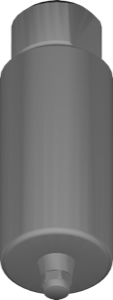
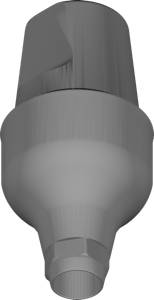
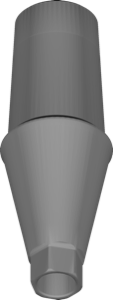
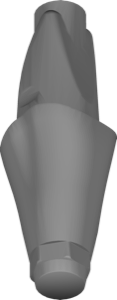
DIO for exocad: 158 UF II Libraries — Selection Guide
DIO Corporation is one of South Korea's largest implant manufacturers, and its flagship UF (UF II) range has long been part of digital workflows. If you're looking for a DIO implant library for exocad, be ready for this: a single brand hides more than a hundred separate files — one for each combination of platform, abutment type and gingival height. The DentalLibs catalog for exocad DentalCAD holds around 158 DIO UF II libraries, and their logic is easier to grasp than it looks.
DIO UF II libraries for exocad: what's in the range
Almost all available libraries belong to the DIO UF Submerged (Sub) type — a two-stage, bone-level system. Within it, files split into several families, and the file name tells you quickly which component you're dealing with:
- Regular Hex CA — the UF Submerged connection interface with a hexagon (engaging).
- Cemented ABT (SSCA, UNSCA) — cemented abutments for various heights and diameters.
- Digital ABT (DUR, DPR, DUN, DMR, DCR, DLN) — digital abutments for the CAD/CAM workflow.
- Hybrid Link (UFHL, UNHL) — hybrid links, the equivalent of a titanium base (Ti-Base).
The numeric code at the end of the name — for example 65505 or 40405 — encodes the dimensional parameters of the item: gingival cuff height, abutment height and diameter. Read the exact values from the DIO catalog: you need to pick the library whose reference matches the physical part down to the last digit.
DIO UF Submerged: connection and Regular Hex
Everything is built on the connection interface. The DIO UF Sub Regular Hex CA library describes a conical connection with an internal hexagon in the engaging variant, meaning it has anti-rotation geometry. This is what defines how the component seats on the implant and how it is positioned in the exocad project.
Engaging (with a hexagon) is used for single crowns that need anti-rotation. For bridges and bars on several implants, the non-engaging variant is more common, to compensate for non-parallel placement. In DIO's nomenclature this is reflected through the abutment type, so check the "connection + abutment" pairing together.
DIO cemented abutments: SSCA and UNSCA
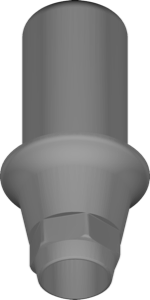
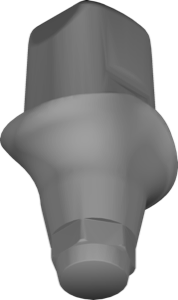
The largest group in the catalog is the cemented abutments (Cemented ABT). There are two prefixes here: SSCA and UNSCA. Files like SSCA 65505 or UNSCA 40405 give exocad the ready-made abutment geometry onto which a cement-retained crown is designed.
The difference between the series lies in geometry and platform purpose. UNSCA references (40205, 40405, 40505, 40607) describe a universal group, while SSCA (45404, 55405, 65505, 75104, etc.) covers a wider range of heights and diameters. Two things matter for correct selection: platform match and the gingival cuff height encoded in the reference.
- SSCA — cemented abutments, wide dimensional range.
- UNSCA — universal cemented series.
- Selection — strictly by the reference printed on the component packaging.
DIO digital abutments (Digital ABT): DUR, DPR, DUN, DMR
For the CAD/CAM workflow, DIO offers digital abutments (Digital ABT) — the catalog has plenty of these too. They differ by prefix: DUR, DPR, DUN, DMR, DCR, DLN. For example, Digital ABT DUR 4570 or DPR 1555 are blanks for custom milling or scanning.
A practical rule: digital abutments are used when the abutment is designed individually (custom abutment) on a scan body, while cemented SSCA/UNSCA are used when working with stock geometry. The prefix (DUR/DPR/DMR, etc.) usually indicates the series and fit type, and the number indicates the size; check against the DIO nomenclature.
Hybrid Link and Ti-Base: DIO hybrid components
A separate family is the Hybrid Link with the prefixes UFHL and UNHL. These are DIO's hybrid links, functionally close to a titanium base (Ti-Base): a milled or printed superstructure is bonded onto them, while the link itself provides the metal connection to the implant. The Hybrid Link UFHL 45501 library holds the geometry of exactly this link.
UFHL and UNHL differ by platform and by whether anti-rotation is present: as with abutments, engaging versions are for single restorations and non-engaging for splinted structures. Height and diameter are again encoded in the numeric code (45403, 55401, 40402, etc.).
How to choose the right DIO library in exocad
The logic for selecting a DIO library follows the general principle for implant libraries: system first, then platform, then the specific component. Errors most often occur at the last step — when a "similar" reference is chosen instead of the exact one.
- Identify the system: almost always UF Submerged (Sub).
- Choose the component type: Regular Hex, Cemented ABT, Digital ABT or Hybrid Link.
- Match the series prefix (SSCA/UNSCA/UFHL/DUR…) with the part in hand.
- Match the numeric reference — cuff height and diameter must be exact.
- Check engaging/non-engaging for the clinical situation.
All the listed DIO UF II libraries are available in the DentalLibs catalog for exocad DentalCAD — with filtering by prefix and reference, which noticeably speeds up finding the right file.
Frequently asked questions about DIO libraries for exocad
How many DIO libraries are there for exocad?
The DentalLibs catalog holds around 158 libraries of the DIO UF II range for exocad DentalCAD — one for each combination of component, platform and size.
How does SSCA differ from UNSCA?
Both are DIO UF cemented abutments. SSCA covers a wide dimensional range, UNSCA is a universal series. Selection is always by the exact reference on the packaging.
What is a Hybrid Link at DIO?
It's a hybrid link (UFHL/UNHL) — the equivalent of a Ti-Base titanium base, onto which a custom superstructure is fixed. In exocad it needs its own dedicated library.
What does the number in the name mean, for example 65505?
The number encodes the component's dimensional parameters — gingival cuff height, abutment height and diameter. Check the exact values in the DIO nomenclature and pick the library strictly by an exact match.