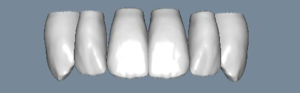
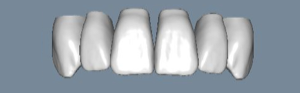
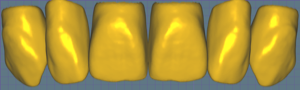
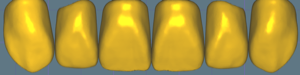
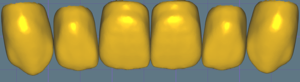
VITA vs Zirkonzahn: Which Tooth Anatomy to Pick in exocad
In exocad DentalCAD, an anatomy library is a set of reference morphologies (reference shape) that the CAD uses as a starting point when building crowns, bridges and veneers. In the DentalLibs catalog it's the most underrated category: 444 anatomy libraries against a couple dozen tooth moulds in the base package. And almost all the search demand is pulled by two lines — VITA tooth library for exocad and Zirkonzahn anatomy.
Both come from manufacturers, but their logic differs. Below we break down how the VITA Physiodens mould codes differ from the named Zirkonzahn anatomies and when it makes sense to move to author sets.
What Is an Anatomy Library in exocad DentalCAD
When you model a crown, exocad doesn't sculpt the shape from scratch. It takes a ready-made set of morphologies — upper and lower teeth with defined cusps, fissures and marginal ridges — and uses it as the starting geometry. Then the biogeneric steps in: it scales and deforms the reference to fit adjacent teeth, antagonists and the preparation margin.
The takeaway is simple: the quality and character of the work are largely set by the very anatomy you loaded. A smooth modern molar and a strongly textured incisor are two different libraries, not two sliders in the interface. So it makes sense to keep several sets on hand for different tasks.
VITA Tooth Library for exocad: How Physiodens Moulds Work
VITA carries its familiar artificial-tooth logic into the digital world. Library names are the mould codes of the Physiodens line (Physiodents in exocad's spelling): a letter and a number describe the shape, while the S/M/L suffix marks the size (small/medium/large). This approach is handy if a technician already knows the physical VITA moulds and wants the same character in CAD.
The range is wide. VITA Physiodens T6S gives a wide contour and a slightly shortened length, Physiodens T7M offers a balanced medium morphology, T1S is a narrow "young" shape, and T6L is a large, expressive tooth. There are also combined sets like T6S L1S O25E U25E that gather several moulds into one library.
Zirkonzahn Anatomy: Named Sets and PhonarES
Zirkonzahn takes a different route. Instead of mould codes, it uses its own names, often from mythology. Behind each name is a distinct tooth character: some restrained and natural, some deliberately pronounced. Standing apart are sets based on the PhonarES Bold mould and numbered series like Z_10.
For orientation in the catalog: Zirkonzahn PhonarES Bold Universal gives an expressive shape with noticeable texture, while zirkonzahnTRITON offers a more massive, "masculine" morphology. The rest of the sets differ mainly in occlusal pattern and degree of character.
- HERMES, THALIA, RHEIA, PAIAN — complete sets with an even, natural character
- AIDA, AREUS, SERAPHIM, SAO — standalone morphologies with their own occlusal signature
- DEMI, Z_10 — full sets for the standard restorative protocol
- PhonarES Bold, TRITON — expressive shapes for cases that need bold relief
Manufacturer Anatomies vs Author Sets: What's the Difference
The main difference is predictability versus character. VITA and Zirkonzahn libraries are factory-calibrated sets: the same result case after case, tied to a recognizable shape, minimal surprises. For high-volume crowns and bridges that's exactly what you need.
Author anatomies solve a different problem — individuality. Sets like Lorant Stumpf, George Zacusai PRADIP, FOBOS-Pallada, Expression and Gebdi Tribos give a more sculptural, lively relief: pronounced mamelons, natural incisal-edge irregularity, deep fissures. Such libraries shine on the anterior and in esthetic work, where a "non-factory" look matters.
How to Choose Tooth Anatomy for a Clinical Case
Start from the zone and the task. In the posterior, function and occlusal contact matter more — here the even factory sets from VITA and the "restrained" Zirkonzahn lines work more calmly. In the anterior, esthetics comes to the fore, and expressive and author morphologies win out.
Next, factor in the patient's age and sex, paired teeth and matching the removable part if there is one. Keeping one universal anatomy for everything is a compromise; it's more practical to assemble a small working set for typical scenarios. All the libraries listed are available in the DentalLibs catalog.
- Anterior, young patient — narrow/expressive shapes (VITA T1S, PhonarES Bold)
- Posterior group — balanced medium moulds (VITA T7M)
- Masculine character, large teeth — TRITON, T6L
- Combined work with removables — a VITA mould for artificial teeth
- Custom esthetics — author sets with hand-crafted relief
FAQ About VITA and Zirkonzahn Anatomies
How does an anatomy library differ from exocad's base teeth?
The base package gives a few universal moulds. Separate VITA and Zirkonzahn libraries expand the choice to hundreds of characterful morphologies for a specific case.
Can VITA Physiodens anatomy be used for crowns, not just removable dentures?
Yes. In exocad the mould loads as a reference shape for crowns, bridges and veneers. There's no hard tie to removable prosthetics, though matching the artificial-tooth mould is handy in combined work.
What do the letters and numbers in VITA names mean — T6S, Z2S, X1M?
These are Physiodens mould codes: a letter and a number describe the shape, the S/M/L suffix the size (small/medium/large). Check the library card for the exact geometry.
Why does Zirkonzahn use names like HERMES, THALIA, TRITON?
Zirkonzahn names its sets rather than coding them. Each name is a distinct tooth character, from restrained to strongly massive, as with TRITON.