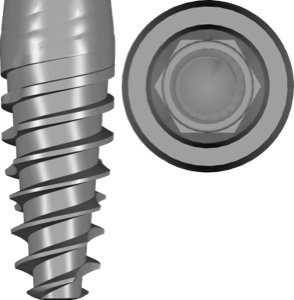
Cone Morse: Which Brands Use It and How They Differ
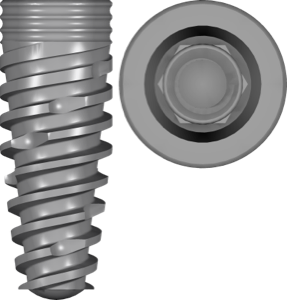
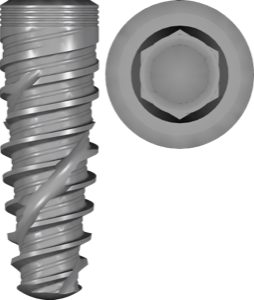
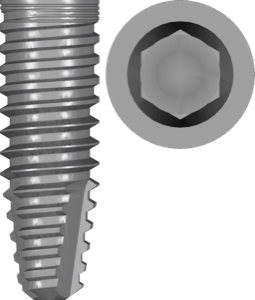
Cone Morse (Morse cone, Morse taper) is a type of implant-abutment connection where a conical shank seats into a tapered bore through friction, with virtually no gap. The term comes from mechanical engineering: the Morse taper has held drill bits and chucks without threads for decades. In implantology, the same principle delivers a tight, self-locking junction.
Below we break down which brands use the Morse taper conical connection, how cone angles differ across systems, and how choosing a conical connection changes prosthetics and CAD library selection.
What Is a Morse Taper Conical Connection
Unlike a flat butt joint with an internal hex, where the abutment rests on a platform and is centered by its flats, a conical connection works on a cone-in-cone principle. The abutment shank enters the implant's tapered bore and wedges in by friction. The walls contact along the full length of the cone, not across a single plane.
This has two practical consequences. First, a minimal microgap at the implant-abutment interface, which reduces micromovement and bacterial leakage into the bore. Second, many conical systems build in platform switching by design: the abutment diameter is smaller than the implant platform diameter, shifting the contact zone inward to help preserve bone.
Which Brands Use the Cone Morse Conical Connection
The conical connection is especially widespread among Brazilian and Italian manufacturers, but it also appears in global brand lineups. Our exoplan catalog features several families.
- Neodent — the Grand Morse (GM) line, along with the classic Cone Morse Titamax and the Conical system (guided kits for guided surgery);
- S.I.N. Implant System — Epikut Plus CM 11.5° and Strong SW with a 16° cone;
- Implacil De Bortoli — MorseTaper AR (Due Cone) and Maestro CM;
- JDentalCare (Italy) — JDIcon Plus with a 5° internal conical connection;
- Kopp, Singular, Derig (CMH — Cone Morse Hexagonal), MEDENS, IDI, DSP Biomedical, Mc Bio — conical lineups for exoplan and RealGUIDE.
Worth a special mention is the classic Morse cone — Ankylos by Dentsply Sirona: one of the systems that made the conical connection recognizable in implantology.
Cone Angles: How Morse Taper Differs Across Brands
The main technical difference between conical systems is the cone angle. It determines the wedging force and seating depth. According to manufacturer data, the spread is wide:
- IDI IDCAM ST — cone of about 2.5°;
- JDentalCare JDIcon Plus — 5°;
- S.I.N. Epikut Plus and DSP Biomedical (CMI Wayfit/Biofit) — 11.5°;
- S.I.N. Strong SW — 16°.
The practical meaning is simple: a small angle (2.5–5°) gives a deep frictional seat close to a "cold weld," while a larger angle (11.5–16°) combines cone contact with a more pronounced anti-rotation feature. That's why a single brand can have different CM lines — for different clinical tasks and prosthetic protocols.
How Prosthetics on Cone Morse Differ
On a conical connection, the abutment is fixed primarily by friction, while the retaining screw (when present) holds the assembly and sets the indexing. This leads to several differences from prosthetics on a flat hex.
First, seating accuracy is critical: the abutment must fully "seat" into the cone, or the height and axis of the restoration will change. Second, there's a distinction between indexed abutments (with anti-rotation — for single crowns) and non-indexed ones (free rotation — for bridges and bar constructions). Third, platform switching of conical systems works toward soft-tissue stability and the emergence profile.
For CAD/CAM this means that the Ti-Base (titanium base) and abutment are selected strictly for the brand's specific conical platform — the cone geometry of Neodent GM, SIN CM and Implacil AR is not interchangeable.
How to Select a Cone Morse CAD Library in exoplan
The exoplan catalog now holds more than 1270 implant libraries, and conical lineups often sit alongside non-conical platforms of the same brand. So when selecting, it's important to match the exact CM series, not just the manufacturer name.
Look for markers in the lineup name: CM, Cone Morse, Morse Taper, GM (Grand Morse), CMH (Cone Morse Hexagonal). Then check the platform and diameter, and pick the matching Ti-Base for them. For Neodent guided surgery there are separate guided kits (Conical, Titamax) — sleeve libraries for the conical protocol.
Verified conical system libraries — JDIcon Plus, the SIN and Implacil lineups — are available in the DentalLibs catalog with an FDA marking for the current versions.
Frequently Asked Questions About Cone Morse
How does Cone Morse differ from other connections?
The abutment is held by cone friction along the full length of the junction, not by flats on a flat platform. This reduces the microgap and micromovement at the implant-abutment interface.
Are Cone Morse and Morse taper the same thing?
Yes. Cone Morse, the Morse cone and Morse taper are synonyms for a conical connection. Manufacturers also use the abbreviations CM, GM (Grand Morse) and CMH.
Which cone angle is better?
There's no universal answer. A small angle (2.5–5°) gives a deeper frictional seat, a larger one (11.5–16°) adds an anti-rotation component. The choice is set by the brand's system.
Are abutments and Ti-Base interchangeable across different CM brands?
No. The cone and platform geometry of Neodent, SIN, Implacil and others differ — select components and library strictly for your own system.