Implant Screw Driver Types: Torx, Hex, Square
When a technician opens a kit from a new brand, they almost always face the same question: which driver to use for tightening the prosthetic screw. The screw heads look alike on the outside, but the drive inside can differ, and that is what decides whether the tool seats fully or strips the socket. Let's break down the main implant screw driver types, hex, Torx and square, and show how the drive shape relates to the connection and CAD library selection.
This is not about the thread of the implant itself, but about the geometry of the screw seat on the head of the prosthetic screw, the very spot where the driver tip enters. This detail is rarely stated in the library name, yet it directly affects the clinical fixation step.
What are the implant screw driver types
All drives come down to a few basic socket shapes. The manufacturer chooses the geometry based on how much torque needs to be transferred without slipping and how compact the screw head has to be.
- Hex (internal hexagon) — an internal hexagonal socket, historically the most widespread drive.
- Torx / hexalobe (six-lobe) — a six-lobe star with a larger contact area.
- Square drive — a four-sided socket, found in older and some budget systems.
- Proprietary drives — Unigrip, Omnigrip, SCS and other patented profiles of specific brands.
It is also worth remembering angled access to the screw: systems with an angulated screw channel (ASC — angulated screw channel, ASA — angulated screw access) often require a special articulated driver rather than a straight one.
Hex: the most common drive
The internal hexagon is the baseline standard of most Korean and many European systems. It is valued for its simplicity and low production cost, but it has a weak spot: stress concentrates on the sharp edges of the socket, and if the driver is misaligned the socket strips easily.
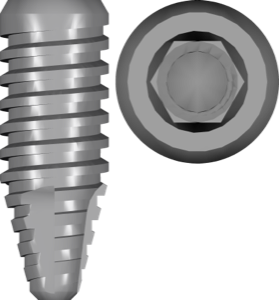
The hex socket size differs between brands, so a driver from one system does not always fit another, even when the sockets look identical. A practical example of a screw solution on a conical connection is the Kopp CM Screw Platinum line in Grade IV titanium: here the screw works as the main retaining element of the restoration.
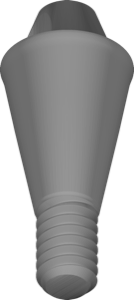
At the level of a screw-retained abutment the seating geometry is defined by the library itself, for example Dentium NR Line Screw Abutment, where the screw abutment is already designed for a specific tightening protocol.
Torx and hexalobe: how the star differs
Torx (more correctly hexalobe) is a six-lobe profile. Thanks to the larger contact area and rounded edges it transfers torque more evenly and is less prone to stripping than hex. That is exactly why many manufacturers switched to this drive in their newer lines.
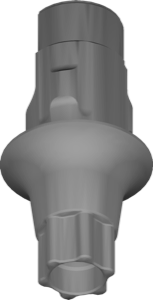
This family also includes the proprietary Straumann SCS (Screw Carrying System) drive, essentially a hexalobe optimized to hold the screw on the driver tip while inserting it into the mouth. In the digital protocol such connections are represented, for example, by the Straumann Variobase-XC ASC library with an angulated screw channel.
Square and proprietary drives: Unigrip, SCS, Omnigrip
The square drive is a legacy of early implant systems. It gives a good grip, but its resistance to stripping falls short of the hexalobe, and it is gradually leaving modern catalogs. Even so, it still appears in archived and compatible components.
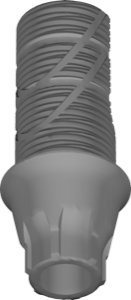
A separate category is patented profiles. Nobel Biocare historically uses Unigrip, and for angled channels Omnigrip, which lets the driver be introduced at an angle. Work with angled screw access is reflected in the NobelProcera Ti ASC library, where the abutment geometry is designed for an angled channel from the start.
Proprietary drives complicate interchangeability: a third-party driver will not fit them, and this is worth considering when purchasing instruments for a specific line.
How the screw type relates to the CAD library
The driver's drive is a hardware detail, and its shape is not stored directly in the library file. But the library defines everything around the screw: the seat in the abutment or Ti-Base, the diameter and profile of the screw channel, and its angulation. So when making a selection it is important to look not only at the connection and platform, but also at notes about screw access.
The key marker is the ASC, ASA or ASA-channel designations in the name. They mean the restoration is designed for angled access, and at the clinical stage a matching articulated driver will be needed rather than a straight one. Straight channels carry no such constraints.
In the DentalLibs catalog such libraries are grouped by brand and connection, and in the exocad DentalCAD section for implants alone there are more than a thousand sets, including multi-unit and Ti-Base variants. This lets you see in advance whether a straight or angled screw channel is built into a specific geometry.
Frequently asked questions about implant screw driver types
Which driver type is the most common in implantology?
The internal hexagon (hex) is the baseline drive of most systems. In newer lines it is increasingly being replaced by the hexalobe (Torx) as more resistant to stripping.
Can you use one brand's driver for another brand's screws?
No. Even with the same socket shape, the sizes and tolerances differ. A foreign driver raises the risk of stripping the socket and damaging the screw.
Why is Torx better than hex?
Six rounded lobes provide a larger contact area, so torque is transferred more evenly and socket stripping is less likely than on the sharp edges of a hex.
What does ASC or ASA mean in a library name?
It is an angulated screw channel / access. Such a restoration is designed for angled access and requires a special articulated driver.