Feminine Tooth Morphology in exocad: Incisor Esthetics
The shape of anterior teeth drives the outcome of a restoration more than the ceramic shade: the eye reads contour before color. Feminine tooth shape design is an approach where the anatomy of the central incisors is built around a soft, rounded character, whereas masculine morphology relies on straight lines and dominance. In exocad DentalCAD both scenarios come down to choosing a reference anatomy library, and the exocad-anatomy section already holds 444 of them — including sets where "feminine morphology" is stated right in the description.
Below we break down the features that set feminine and masculine forms apart, which libraries suit them, and how to load them as a reference shape when designing crowns and bridges.
How feminine tooth morphology differs from masculine
The difference shows up in three features: the contour of the mesial and distal angles, the character of the transition lines, and the relief of the incisal edge.
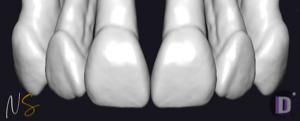
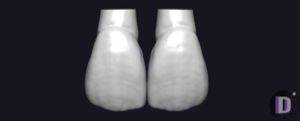
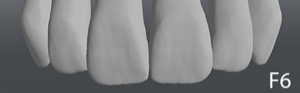
Feminine morphology means rounded incisal angles, smooth facial surfaces, softened mamelons and a light, natural asymmetry. The central incisors look more delicate, the distal angle is gently rounded, and the tooth appears slightly narrower and more elongated.
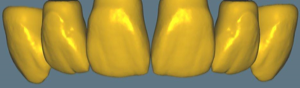
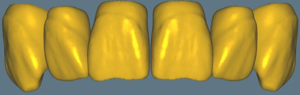
Masculine morphology shows an almost straight distal angle, pronounced vertical transition lines, a flatter facial surface and a dominant, large central incisor. The form reads as decisive and angular.
Feminine morphology: libraries with a feminine tooth character
The DentalLibs catalog offers ready-made author sets whose feminine character is built into the morphology itself. The most recognizable is George Zacusai ANNE: its description explicitly notes a softer, feminine tooth character, so the set is a convenient starting morphology for feminine central incisors.
Alongside it sit the Jan Haito series: Jan Haito F7 is the feminine F7 set, while Jan Hajto F6 offers an alternative feminine reference shape. Another option with a pronounced feminine character is White Lady, loaded as a reference shape when designing crowns and bridges.
All these libraries work the same way: you assign them as the active morphology, and the CAD engine supplies the shape as a starting point for the segment.
Masculine morphology: libraries for large incisors
For angular, dominant incisors, the same author lines provide masculine variants. Jan Haito M7 gives the masculine M7 morphology as a reference shape for crowns, bridges and full-anatomy work; a matching set also exists in the Jan Hajto M7 variant.
Masculine sets deliver a straighter profile and more pronounced relief, which fits middle-aged men and cases that call for a visually strong smile. It is often handy to keep paired F and M libraries from the same author on hand: that keeps the morphological style consistent while only the character of the form changes.
How to match tooth shape to sex, age and facial type
Selecting morphology is the foundation of visagism and the dentogenic concept. The shape should be matched not to a single feature but to their combination:
- Sex — the feminine form is softer and rounder, the masculine one straighter and more angular;
- Age — young patients show pronounced mamelons and sharp angles, while the incisal edge wears down with age;
- Facial type — an oval, square or triangular face sets the incisor proportions;
- Smile character — a delicate or, conversely, a dominant line of teeth.
For mature and elderly patients it makes more sense to use sets with an already smoothed, slightly worn relief, and to save the sharp, youthful forms for patients under 30. Feminine and masculine libraries still remain a reference point, not a finished result.
exocad workflow: how to assign a reference morphology
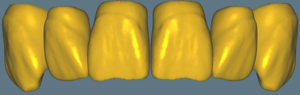
The mechanics are the same for any anatomy library. The library is installed into the exocad tooth database, after which it is selected as the active morphology for the required segment (for example, for the upper central incisors). CAD supplies the shape as a starting point, and from there you work with the morphing tools: scale, tilt, angles, transition lines.
A practical tactic is to keep several libraries in reserve and switch them right inside the project, comparing how the feminine and masculine forms sit on a specific smile. That way the esthetic decision on the central incisors is made on a live model rather than blindly.
What is feminine morphology in exocad libraries?
What does feminine morphology mean in an anatomy library?
It is a set of tooth shapes with rounded angles, soft facial surfaces and a smoothed relief, conceived as a feminine character. In exocad it is loaded as a reference shape and serves as a starting morphology.
Can feminine and masculine libraries be mixed in one case?
Yes. Different segments can be built from different libraries — for example, giving the central incisors a character from one morphology and the laterals from another to achieve a natural asymmetry.
Which library should I choose for feminine central incisors?
Start with sets where the feminine character is stated in the description: George Zacusai ANNE, Jan Haito F7 or White Lady. Still refine the final form with morphing to fit the patient's face.
Are these libraries only suitable for crowns?
No. Author sets like Jan Haito are used for crowns, bridges and full-anatomy work, so the same morphology can be applied across different types of restorations.