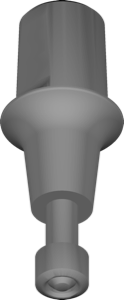
Astra EV vs Ankylos: which Dentsply cone to choose
Both connections belong to Dentsply Sirona and both are conical, so the question of Astra EV vs Ankylos comes up regularly — especially when picking a CAD library. The systems are easy to confuse by brand name, but their connection geometry, platform logic and prosthetic components are not compatible with each other.
Below we break down how the Conical Seal Design of the Astra Tech Implant System EV differs from the TissueCare Connection of Ankylos, how that affects platform selection and which libraries you will need in exocad and exoplan.
Astra Tech EV: Conical Seal Design and color-coded platforms
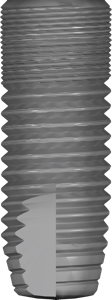
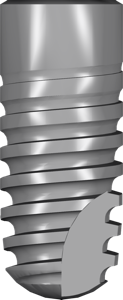
Astra Tech Implant System EV is the current generation of the Astra system. At its core is the Conical Seal Design: an indexed internal conical connection that sets the abutment position. It is complemented by the OsseoSpeed surface, the MicroThread microthread in the cervical zone and the Connective Contour profile for soft-tissue support.
The key feature of Astra EV is that the platform is tied to the implant diameter and marked by color. Each diameter has its own connection size, so when picking a library it is not enough to just select "Astra EV" — you have to hit the specific platform.
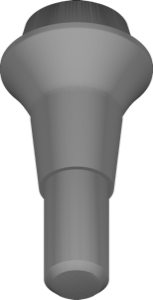
The implant range includes OsseoSpeed EV and OsseoSpeed EV Profile for a sloped ridge. On the prosthetic side, the system uses ASA abutments (Astra Straight Abutment), TitaniumBase EV titanium bases and MultiBase Abutment EV for screw-retained restorations.
Ankylos: TissueCare Connection and Morse taper
Ankylos is built around the TissueCare Connection — a deep self-locking taper (Morse taper). The connection is frictional: the abutment seats into the implant with an interference fit, which minimizes the microgap and micromovement at the implant–abutment interface. Platform switching is designed in, and the implant itself is intended for subcrestal placement.
The main difference in the Ankylos philosophy is a single connection for all diameters. The implant diameters (A, B, C, D) use one mating geometry, so the prosthetics are not tied to the diameter as strictly as with Astra EV. There are two versions: C — without an index and C/X (CX) — with an index for unambiguous prosthetic positioning.
For removable and bar-supported restorations the system uses BalanceBase abutments in straight and angled versions, along with the standard Ankylos prosthetic platform.
Astra EV vs Ankylos: the main difference between the connections
Boiled down to the essentials, the difference comes down to two things: the type of taper and the platform logic.
- Type of taper: Astra EV is a shallow indexed conical lock (Conical Seal); Ankylos is a deep self-locking Morse taper (TissueCare).
- Platform and diameter: with Astra EV the platform is tied to the diameter and color-coded; with Ankylos a single connection serves all diameters.
- Indexing: Astra EV is indexed by default; with Ankylos the index only appears in the C/X version.
- Prosthetics: TitaniumBase EV, ASA, MultiBase EV versus BalanceBase, standard abutments and Atlantis.
Ti-Base and abutment libraries for exocad
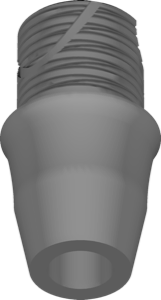
In exocad, Astra EV most often needs a titanium base. TitaniumBase EV comes in S / M / L geometries and with different gingival heights (the catalog offers options from 1 to 4 mm, including NI, non-indexed versions). For screw-retained restorations the system uses the MultiBase Abutment EV.
For Ankylos, the digital protocol uses BalanceBase Multi-Unit — straight and angled — along with the base Ankylos geometry and Atlantis abutments, including versions for printing models.
Note: the Ti-Base (titanium base) of one system does not fit the other, even though both are called "conical" — their mating cone and index are different.
Planning and surgical guides in exoplan
For planning and guided surgery in exoplan you need separate implant and surgical kit libraries. For Astra choose OsseoSpeed EV plan FDA (there is also a Profile version and the previous TX generation), and for Ankylos — Ankylos C/X plan FDA.
For the guides there are GS kits: AstraTech EV Proline GS kit and Ankylos GS kit — chosen to match the specific surgical protocol of the system. All the listed Dentsply Sirona libraries are available in the DentalLibs catalog.
Frequently asked questions about Astra EV and Ankylos
Are Astra EV and Ankylos components compatible?
No. These are two different conical connections, and their abutments, Ti-Base and Multi-Units are not interchangeable.
What is the difference between Ankylos C and C/X?
C is a connection without an index, C/X (CX) has an index for unambiguous prosthetic positioning. The library is chosen for the version you need.
How do I choose an Astra EV platform in the library?
With Astra EV the platform is tied to the implant diameter and color-coded, so pick the library strictly by platform, not just by product line.
Is Astra EV the same as Astra Tech TX?
No. TX is the previous Astra generation, EV is the current one with an updated Conical Seal Design. TX and EV require different libraries.